Manufacturing and Industrial Principles

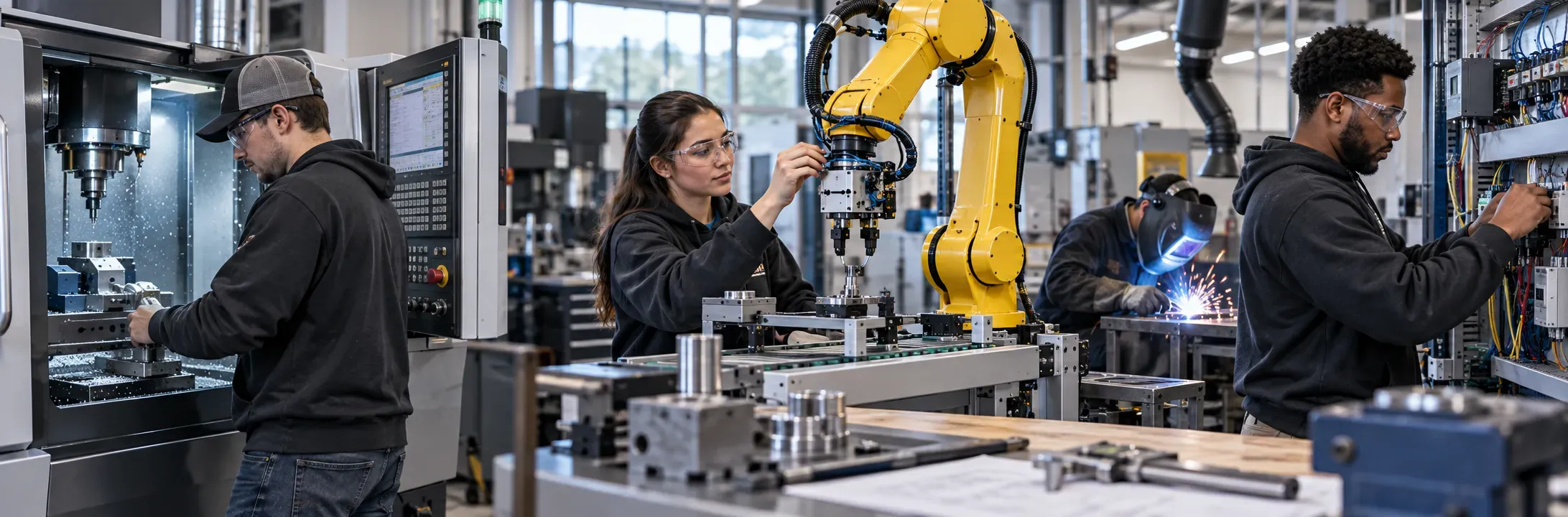
Manufacturing and Industrial Principles prepares students for careers in advanced manufacturing through hands-on training in machining, robotics, industrial wiring, fabrication, and maintenance. Students develop practical skills using industry-standard equipment and can be workforce-ready in as little as two semesters.

Why Consider Manufacturing and Industrial Principles?

  • You enjoy hands-on learning and working with equipment or technology.
  • Careers in this field are in demand across a variety of industries.
  • Graduates may pursue a variety of career paths and advancement opportunities within the industry.
  • Being part of the manufacturing process can be rewarding.
  • Hands-on, detailed work appeals to you.
  • You’re interested in learning how things work and keeping them running.

Why Learn at Lakeshore?

  • Gain hands-on training using industry-standard equipment, tools, and technology.
  • Learn from experienced instructors with professional industry backgrounds.
  • Coursework is designed to prepare students for immediate entry into the workforce.
  • Students develop practical, real-world skills through applied learning opportunities.
  • With frequent start dates, begin when it’s convenient for you.
  • In just two semesters, you can be workforce-ready.

What It Takes?

Successful students in this program typically demonstrate:

  • Mechanical aptitude and attention to detail
  • An interest in how things work
  • Willingness to take on responsibilities and challenges
  • Interest in operating advanced machines
  • Ability to follow job orders, drawings, blueprints, and specifications

Career Area
Advanced Manufacturing
Type
Technical Diploma
Program Number
30-462-8
Availability
CBE
  • Technical Diploma
  • 2 Terms
  • 19 Credits
  • Hands-On, Applied Learning
  • Multiple start dates each year
  • Partially Financial Aid Eligible

Career Outlook

Manufacturing and Industrial Principles

Median Income: $57,002.00*

POTENTIAL JOB TITLES

(Click a title for job description)

Apply electrical and electronic theory and related knowledge, usually under the direction of engineering staff, to design, build, repair, calibrate, and modify electrical components, circuitry, controls, and machinery for subsequent evaluation and use by engineering staff in making engineering design decisions.

Operate, test, maintain, or calibrate unmanned, automated, servo-mechanical, or electromechanical equipment. May operate unmanned submarines, aircraft, or other equipment at worksites, such as oil rigs, deep ocean exploration, or hazardous waste removal. May assist engineers in testing and designing robotics equipment.

Repair, install, adjust, or maintain industrial production and processing machinery or refinery and pipeline distribution systems.

Disclosure:

*Lightcast/EMSI data is a hybrid dataset derived from official government sources such as the US Census Bureau, Bureau of Economic Analysis, and Bureau of Labor Statistics. This salary data is from the Lakeshore District.

ADMISSION AND FIRST SEMESTER ENROLLMENT STEPS

*Submit transcripts and test scores (optional, highly recommended): College transcripts, along with high school transcripts and test scores from within the last five years, used for course registration. Official transcripts needed for transferring college credit(s) and for financial aid purposes.

Program Cost

  • Tuition Cost: $3057.50
  • Book Cost: $1130.00
  • Supply Cost: $0.00
  • Program Total: $4187.50

COMPETENCY-BASED EDUCATION is a learning model offering far more flexibility than traditional models. Fitting college around your work and personal commitments is possible because CBE allows you to:

  • Learn When You Want To
  • Progress at Your Own Pace
  • Receive Personalized Coaching & Support  

Learn More About CBE

Faculty Bios

Instructor Bios Globe

David Saunders

I worked in the field of welding and fabrication for 35+ years and having the opportunity to pass my knowledge down to others is so rewarding. Teaching is one way to give back to an industry that has given me many opportunities.

Learn More About This Instructor
Instructor Bios Lamp

Brian Strebe

I worked in the field of welding and fabrication for many years. I enjoy sharing with others my knowledge and teaching them a new skill set that will get them started in a very rewarding career.

Learn More About This Instructor
Instructor Bios Globe

Jeremy Dekker

As a welding educator, I am excited to share my experiences with today's future Welders and Fabricators and watch them grow in this profession! 

Learn More About This Instructor
Instructor Bios Books

Mitchell Schmidt

Being a welding instructor involves more than the classroom and textbook teaching. Throughout mentoring and coaching, I strive to create a high skill level for all students so that they are successful in the welding industry.

Learn More About This Instructor
Instructor Bios Globe

Mark Lorier

I enjoy sharing what I have learned in this trade and helping to teach and inspire students in the future of manufacturing.

Learn More About This Instructor
Instructor Bios Books

Mark Sieben

Being an educator allows me to be able to pass on the knowledge and skills that I have aquired over my years in industry to the next generation of workers.  I am able to present this information to students in a way that makes what they are learning relevant to their career.  

Learn More About This Instructor
Instructor Bios Books

Ben Adams

Life is a journey - not a destination.

Learn More About This Instructor
Instructor Bios Books

Brenden Olds

Building a knowledge base in electro-mechanical technology is to build a knowledge base in the very infrastructure that facilitates our modern way of life. 

Learn More About This Instructor
Instructor Bios Lamp

Richard Pfister

Being a Tool and Die/Machinist Instructor is much more than teaching how to run a machine -- it is about teaching innovation and watching students' knowledge about the Industry grow. 

Learn More About This Instructor